 Taking Chopin's own letters as the prime source, our ambition
was to produce a new kind of biography on this Icon of music: not only a well-researched
and authoritative document, but also a book that would inspire a second or third reading -
to discover something new. To this end, we have introduced glimpses of some of the
political and cultural developments that shaped the romantic era of the 19th century. Such
glimpses trigger in themselves many thoughts and questions. Taking Chopin's own letters as the prime source, our ambition
was to produce a new kind of biography on this Icon of music: not only a well-researched
and authoritative document, but also a book that would inspire a second or third reading -
to discover something new. To this end, we have introduced glimpses of some of the
political and cultural developments that shaped the romantic era of the 19th century. Such
glimpses trigger in themselves many thoughts and questions.Towards
the completion of the book, we fell upon a strange episode that occurred in Paris a few
months before Chopin, financially poor, died of ill health. Chopin received in July 1849 a
parcel with 25,000 francs from an anonymous donor (today equivalent to nearly 100,000
euro). In 2003, the circumstances of this mysterious donation were still
unresolved, although Jane Stirling (a Scottish acquaintance and earlier
pupil) and her sister had taken credit for this gesture.
Since we over a short period of time had read all of Chopin's letters
including those from the 1848-1849 period, we spotted a remarkable symbolism, typical for
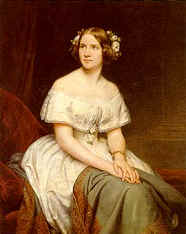
the Romantic era, that unravelled the identity of the true benefactor, Jenny Lind,
The Swedish Nightingale. We also discovered that a beautiful but doomed romance had
unfolded in secret between Chopin and Jenny Lind since early May 1848.
 Chopin
and Jenny Lind's romance had the proportions of a Shakespearean drama that brought us back
to the love-and-death symbols of Romeo and Juliet and Orpheus and Eurydice.
This real-life drama created a role for Hans Christian Andersen
and his story The Nightingale (written in 1843), as well as for Bellini,
Mendelssohn and Schumann. Chopin
and Jenny Lind's romance had the proportions of a Shakespearean drama that brought us back
to the love-and-death symbols of Romeo and Juliet and Orpheus and Eurydice.
This real-life drama created a role for Hans Christian Andersen
and his story The Nightingale (written in 1843), as well as for Bellini,
Mendelssohn and Schumann.
We hope that our discovery will lead to new initiatives in many
countries to celebrate the music of Chopin and the voice of Jenny Lind. We believe
that such initiatives will stimulate a general interest in Icons of art, music, literature
and science, and create new opportunities to demonstrate the power of culture.
Cecilia and Jens Jorgensen |